A 5K start line needs fewer units than a marathon finish festival, but Hawthorne race organizers should plan on one standard unit per 50 to 75 runners, plus at least one ADA unit per cluster under ADA Standards section 213.2. Route length and aid station count change the math fast.
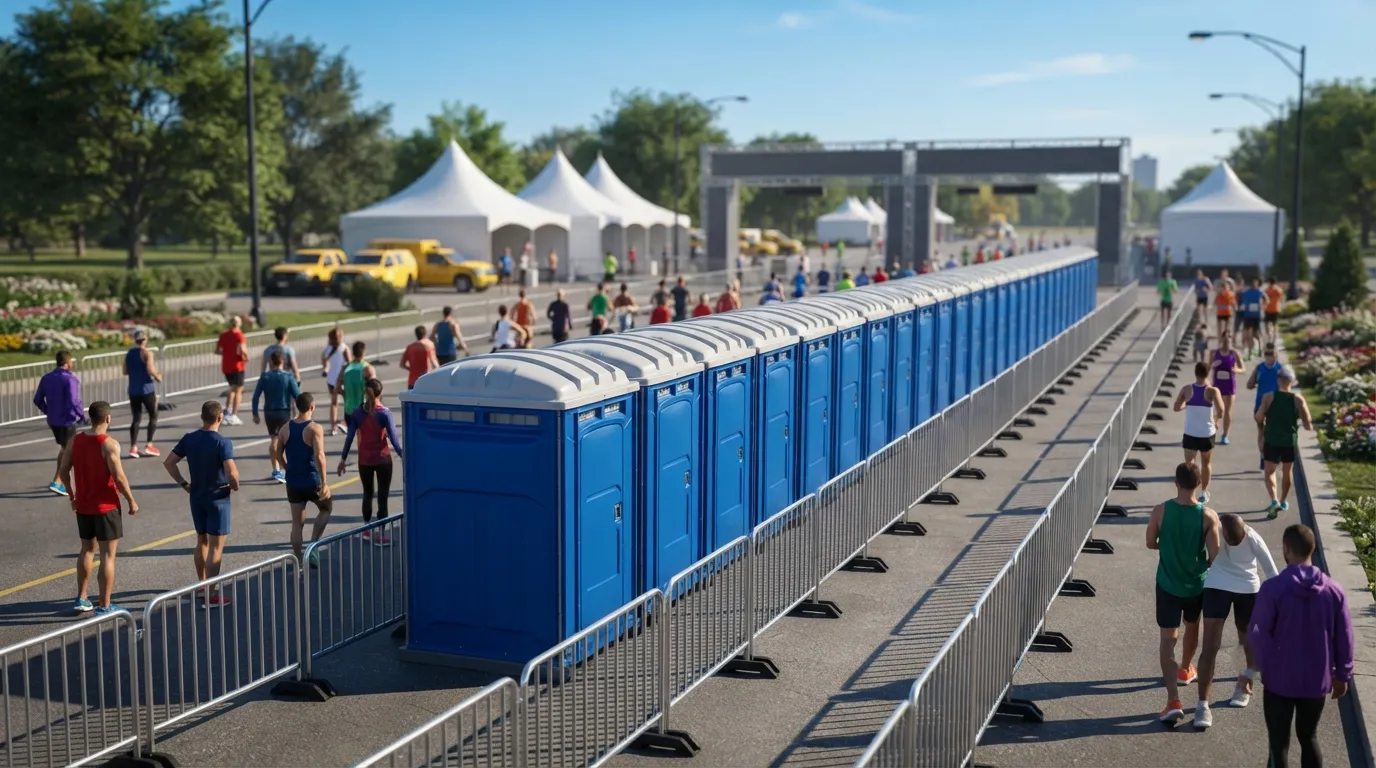
Start with the crowd, not the mileage. A start corral holding 400 runners in Hawthorne needs a real cluster right at the line, and finish festivals need another cluster sized for spectators who linger. OSHA 1926.51(c)(1) sets construction-site ratios, but race organizers use it as a rough planning baseline too: one toilet for smaller gatherings, scaling up as headcount climbs. A standard unit runs about 44 by 48 inches on the ground and stands roughly 92 inches tall, so tight sidewalk staging near a start line in downtown Hawthorne still has room if you plan the footprint early. Aid stations along the course often need just one or two standard porta potty units each, spaced by mile marker rather than clustered. For a finish line festival, pair standard units with at least one ADA accessible porta potty per grouping, since ADA Standards section 213.2 requires it whenever units are clustered together. If your race draws a big spectator crowd, a restroom trailer rental at the finish line festival area handles volume better than a long row of single units, and an 8 stall restroom trailer can anchor a busy finish zone while standard units cover the rest of the course.
| unit | day | weekend | week |
|---|---|---|---|
| standard | 100-350 | 125-400 | 130-500 |
| ada | 200-400 | 199-300 | 120-240 |
| deluxe | 85-1200 | - | 150-290 |
Most Hawthorne races run one day, so the day or weekend column is what applies. A single-day event usually books standard porta potty rental units at the day rate, then adds ADA units per the cluster rule above. Multi-day festival weekends, like a Saturday expo plus Sunday race, often land in the weekend band instead, which is priced as a block rather than two day rentals stacked together. Check current numbers on the porta potty rental cost page before you lock a headcount, and if your event needs handwashing stations too, handwashing station rental pricing is separate from the toilet count entirely. Races with an expo village sometimes add a temporary fence rental to manage crowd flow near restroom clusters, and a crowd control barrier rental keeps lines orderly at a busy aid station. If the finish area needs lighting for an early morning start, a light tower rental covers the setup window before sunrise, and if generators or timing equipment need power, a temporary power pole has to be braced properly. How to brace a temporary power pole matters here: guy wires or a stable base plate keep the pole upright against wind and foot traffic near a crowded finish chute, and it should never be load-bearing for anything beyond the intended circuit.
Placement follows the runners, not convenience for the truck. Every cluster needs a stable, level surface under ADA Standards section 302.1, and the accessible route into any unit needs a minimum 36 inch clear width under ADA Standards section 403.5.1. Door openings on ADA units must clear 32 inches per ADA Standards section 404.2.3, and inside the unit a 60 inch turning circle is required under ADA Standards section 304.3.1. Start lines in Hawthorne often sit near street parking, so delivery trucks need roughly 60 feet of straight clearance to place units without blocking traffic. Aid stations mid-course should sit just off the running lane, not in it, with enough shoulder width for a walker to pass. Finish festivals draw the biggest crowds and deserve the densest cluster, ideally paired with a portable sink rental or two nearby so runners can rinse off sports drink and gel wrappers before heading to food trucks. For races that stage in Hawthorne but draw runners from Lawndale, 2.3 miles south, or Manhattan Beach, 5.2 miles west, our service areas page covers delivery across that footprint. If your event needs a broader look at capacity planning, the how many porta potties do I need guide walks through the math step by step, and general event restroom rental guidance applies just as well to a race weekend as it does to a fair.
Book as soon as your course map and headcount are set, ideally weeks out. Race weekends compete with other Hawthorne events for the same trucks, and ADA units are lower in supply. Waiting until race week limits your options and may force a smaller cluster than your headcount needs.
Every cluster needs at least one ADA unit, including aid stations, not just the finish. ADA Standards section 213.2 applies wherever units are grouped. A single aid station with two standard units still needs one accessible unit alongside them.
Yes, though most small races do fine with standard units and skip the trailer cost. A restroom trailer rental makes more sense for a big finish festival with vendors and spectators lingering, not a quick out-and-back course with a small field.
Construction ratios come from OSHA 1926.51(c)(1) and are built around workers on site for a full shift. Race crowds are transient and concentrated at start, aid stations, and finish, so placement matters more than a strict per-head ratio.
No, they are ordered separately. A handwashing station rental or portable sink rental is priced and delivered apart from toilet units, though many Hawthorne race organizers place them right next to the restroom cluster at aid stations and the finish.
Yes. Hawthorne Porta Pros delivers marathon and race restrooms across Hawthorne and the surrounding metro, with same-day and next-day drop-off available on most orders.
Pricing depends on the unit and how long you need it. See our cost breakdown and request a free quote for an exact figure.
Standard rentals include scheduled service — a pump-out, a clean, a restock and fresh deodorizer. Busy or hot-weather sites can be serviced more often.
Call now or request a free quote — clean units, on-time delivery, transparent pricing.